
What You’ll Find This Week
HELLO {{ FNAME | INNOVATOR }}!
You’re not the only one with the subtle but overwhelming sense that you simply can’t keep up with the rate of change demonstrated by AI. Companies are announcing mass layoffs simply to free up capital to pay for non-human workers. The news cycle (and the hype cycle) are fraught with questions about what happens as more and more people are displaced from their jobs.
But don’t worry, there’s a glimmer of hope on the horizon. As long as you don’t mind becoming a part of the gig economy. And working for a machine.
This week, I’m exploring the impacts of the latest “innovation” in AI: humans. That’s right, we are now “the meatspace layer of AI.” Not clear what that means? Let me tell you…
Here’s what you’ll find:
This Week’s Article: The Market Built to Overcome AI's Biggest Constraint
Don’t Miss Our Latest Podcast
This Week’s Article
The Market Built to Overcome AI's Biggest Constraint
Renting a human is nothing new.
Uber, DoorDash, and TaskRabbit trained us to expect that if we need something done, a person will show up and do it.
Call a car. Get dinner. Mount the TV. Drop off the package. Different jobs, same basic model: a human asks, software routes, another human does the work.
After holding for more than a decade, that model is beginning to shift under the pressure of the AI wave.
AI no longer needs a human to initiate the task.
AI Escapes the Screen
The labor story around AI has been framed in blunt terms from the start. Jobs lost. Teams cut. Roles compressed. For the last two years, companies have asked how much work software can absorb, how many people they still need in the loop, and whether the huge spend on models, chips, and data centers will turn into real operating leverage.
Most of that debate has played out inside the screen. The work under pressure has been digital work: writing, coding, support, research, analysis, scheduling, triage. In other words, the kinds of tasks AI can touch without ever leaving software. But once systems get good enough to identify a task, scope it, and push it forward on their own, the pressure doesn’t stay there. It moves to the next bottleneck.
And the next bottleneck is physical execution.
Someone still has to open the door, check the shelf, pick up the package, walk the block, scan the room, or verify that what the system believes is true is actually true. That’s where the current AI story gets more complicated than the usual “jobs destroyed” narrative. The technology isn’t only removing work. It’s reorganizing work around its own limitations. The machine can handle more of the planning and coordination. The person gets pulled toward the edge cases, the real-world tasks, and the last-mile execution the system still can’t complete for itself.
At that point, the question shifts to labor. What work gets pushed onto people when the software can start the job but still can’t finish it?

Human Labor Gets Pushed to the Edge
The labor story starts to split here.
The loudest version of the AI debate has been about replacement. Which jobs disappear? Which teams get cut? Which functions get compressed into software? That fear is real, and in plenty of cases it’s justified.
AI is also creating work. The problem is that the work it creates often sits downstream of the work it destroys.
As machines take over more of the planning and coordination, the remaining work gets pushed outward into execution.
That doesn’t look like the old knowledge work that’s getting squeezed. It looks more like execution on demand.
In the old marketplace model, a person was serving another person through software. In this new model, the person is increasingly serving a machine-run process. The request may still end in a human task, but the logic behind the task no longer begins with a customer deciding they want help. It begins inside the system.
Seen that way, AI isn’t just changing tasks. It’s starting to rewire the structure of labor itself. As machines take over more of the front end, people get pushed toward the physical work, the edge cases, and the execution layer software still can’t absorb.

Human Labor Becomes Infrastructure
People are no longer just participating in digital marketplaces. They’re becoming infrastructure for machine-run processes, or what RentAHuman calls “the meatspace layer for AI”: the flexible layer that handles whatever the software still can’t.
That matters because it changes where human labor sits in the system. The person is no longer just the customer, the operator, or the worker completing a one-off request. The person becomes the bridge layer that keeps the workflow moving when the machine reaches the edge of its own capability.
That bridge layer shows up wherever software can identify the task, coordinate the task, and value the task, but still can’t complete the real-world step on its own. Open the door. Check the shelf. Verify the package. Scan the room. Confirm the condition. Finish the part that still requires a body in space.
Some of that work will be temporary. Some of it will turn into repeatable job categories. Some of it will become the training ground for later automation. But right now, it marks a new role for human labor inside AI systems: not outside the workflow, and not fully in control of it, but embedded inside it as the execution layer that keeps it running.
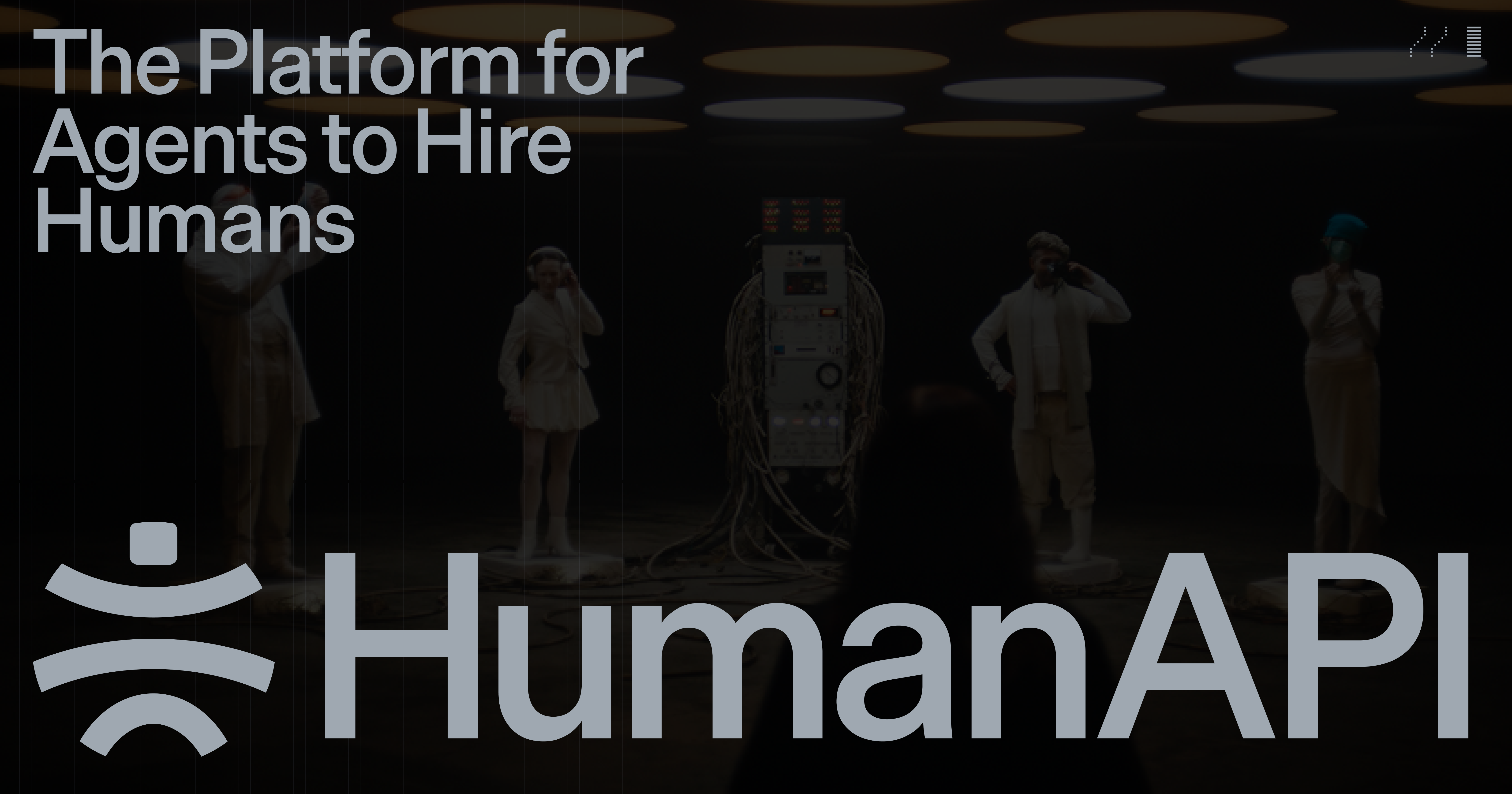
Platforms like RentAHuman and Human API put that role into plain view.

From Uber and TaskRabbit to RentAHuman and Human API
Uber, DoorDash, and TaskRabbit made labor easier to find, but they never changed where authority lived. A person still decided what needed to happen. The app made the transaction cleaner. It did not create the job.
In the old model, software sat in the middle. It waited for a person to decide that something needed to happen, then it matched supply to demand and kept the process moving. In the new model, the machine can identify the task, define it, choose the worker, and set the job in motion on its own.
That gives machines something they have never really had before at scale: last-mile capability.
Not because the system can physically do the work itself, but because it can now reach through a person and get the real-world part done anyway.
RentAHuman and Human API make that shift visible. They are not just smarter marketplaces. They give machine workflows a way to keep moving when the task leaves the screen and enters the real world.
That is what makes these platforms more consequential than another gig economy app.
The jobs themselves are familiar. Show up somewhere. Check something. Deliver something. Verify something. What changes is where the request begins. It can now originate inside the machine workflow itself.
The old platforms turned human intent into transactions. Platforms like RentAHuman and Human API turn machine processes into labor demand.
And once that happens, software stops looking like a routing engine. It starts looking a lot more like an execution system with humans attached to the edge.
Humans First. Robots Later.
That shouldn’t be surprising. Humans are flexible. They can improvise. They can work in messy environments. They can deal with stairs, bad lighting, broken instructions, weird buildings, missing context, and all the other things that make real-world execution hard to automate.
So in the near term, the cheapest way to give a machine last-mile capability is still another human.
But that isn’t where the pressure stops.
Once people become infrastructure for machine-run systems, the next question is how long that infrastructure stays human. The same logic that makes rented humans valuable in the short term makes them a target in the long term. If a task shows up often enough, follows a repeatable pattern, and matters enough to the workflow, someone will try to automate it.
That’s why the path from rented humans to robotics is so direct.
Human marketplaces do more than fill a labor gap. They map the gap. They show which tasks happen often, where the friction sits, what the edge cases look like, and how much someone is willing to pay to keep the workflow moving.
That information becomes a roadmap for robotics.

And once the target becomes robotic execution, humanoids start to make more sense than they used to. The world is already designed around human height, human reach, human stairs, human doors, human tools, and human workspaces. A machine that can operate inside that environment without forcing the whole environment to be redesigned has a real advantage.
That doesn’t mean every task in this new market ends with a humanoid replacing a person. Some jobs will stay too messy. Some will stay too rare. Some will never support the economics.
But the direction of travel is clear.
Humans are the first bridge. Robots are the pressure building behind them.
What This Changes About Work, Roles, and Organizations
The deeper consequence here is a new way of organizing work.
For years, most companies treated AI as a software layer. A tool to help employees move faster, make better decisions, and automate pieces of knowledge work.
Machines initiating work forces a different question: where do people now sit in the system?
Some roles will keep moving upward, closer to oversight, judgment, exception handling, and system design. Other roles will get pushed downward, toward fulfillment, verification, last-mile execution, and the physical work the machine still can’t complete on its own.
That split starts to reorganize work inside the company.
The old model assumed that software supported labor. The emerging model pushes labor into supporting software. In one world, the person uses the system to get work done. In the other, the system uses the person to finish what it started.
That changes org design. It changes role design. It changes where control sits. It changes which work gets treated as strategic and which work gets treated as infrastructure.
And it means “human in the loop” starts to mean something very different. In a lot of cases, it no longer describes judgment at the center of the workflow. It describes labor at the edge of it.
The companies that understand this early won’t treat it like a simple AI adoption question. They’ll treat it like a redesign of work itself.

When Humans Become Infrastructure, What Does Version 2.0 Look Like?
AI hasn’t learned how to replace every worker.
But it is starting to reorganize how work enters the system, how tasks get assigned, and where people sit once the machine can handle more of the planning.
For years, software helped people do their jobs better. Now people are increasingly being pulled into jobs that help software finish its work.
What starts as software coordinating people does not stay there for long. Once the machine can trigger the work, the next pressure is on the human layer still needed to complete it.
That doesn’t mean every worker disappears or every physical task gets automated away. It means the role of human labor is shifting under our feet.
The old question was whether machines would replace people.
The harder question is what happens when machines start directing people, and how long that arrangement lasts before the person becomes just another temporary layer in the stack.
How did this edition land for you?


