
What You’ll Find This Week
HELLO {{ FNAME | INNOVATOR }}!
I’ve spent a lot of time in this newsletter making the case for disruption. Find the friction. Remove it. Unlock the market. Get there before someone else does. Every example I've used, from Canva to Nintendo to AWS, ends the same way: the disruptor wins.
Casper is the version of the disruption story nobody likes to tell. Five founders, a foam mattress, and a $14 billion industry. They did everything the disruption playbook calls for. They hit $100 million in revenue in under two years. Harvard Business School published a case study.
Eight years after launch, a private equity firm bought them at a fraction of their peak valuation. This week, I'm getting into what happened, and what it adds to everything we've said about disruption up to now.
Here’s what you’ll find:
This Week’s Article: The Disruption Worked. The Company Didn’t.
Share This: The Disruption Canvas
Don’t Miss Our Latest Podcast
This Week’s Article
The Disruption Worked. The Company Failed.
Buying a new mattress in 2014 was one of the more reliably horrific ordeals in American consumer life.
You drove to a showroom. You walked through rows of mattresses that looked identical, had names that meant nothing, and were priced in a way that made comparison impossible by design. You lay on a few of them while a salesperson explained why the $2,800 model was worth it and why the one at the other end of the room would leave your back in worse shape than before. You left with the $900 mid-tier option because you couldn't justify the expensive one and couldn't face being the person who bought the cheapest thing on the floor.
In 2014, the mattress industry did roughly $14 billion in annual revenue. It had no meaningful online sales channel. No major player treated online as a real option. The assumption, so obvious nobody said it out loud, was that you had to feel a mattress before you'd buy one.
The industry built its entire model around that assumption.

The People Who Already Knew
Five people decided that assumption was wrong.
Philip Krim had built small e-commerce sites that sold mattresses. Not at major scale, not through established retail channels. But enough to know the model was possible, and that the incumbent industry had never seriously tested the idea.
Jeff Chapin had worked at a design firm serving the major mattress brands. He knew their products from the inside, and had a clear view of where the design and manufacturing logic served the seller rather than the buyer.
Neil Parikh's family had a background in sleep medicine. Luke Sherwin and a co-founder lived in a fourth-floor walkup apartment and couldn't figure out how to get a queen mattress up the stairs, which led to a simple question: why does it have to come this way?
These weren't outsiders disrupting through ignorance. They were people who understood exactly what the incumbents had gotten wrong, and why.
They raised $1.85 million in seed funding to cover production costs and get operations off the ground. Their first-year revenue goal was $1.8 million.
They hit the revenue target in two months.
The Launch
Casper.com went live on April 22, 2014. Forty units in inventory.
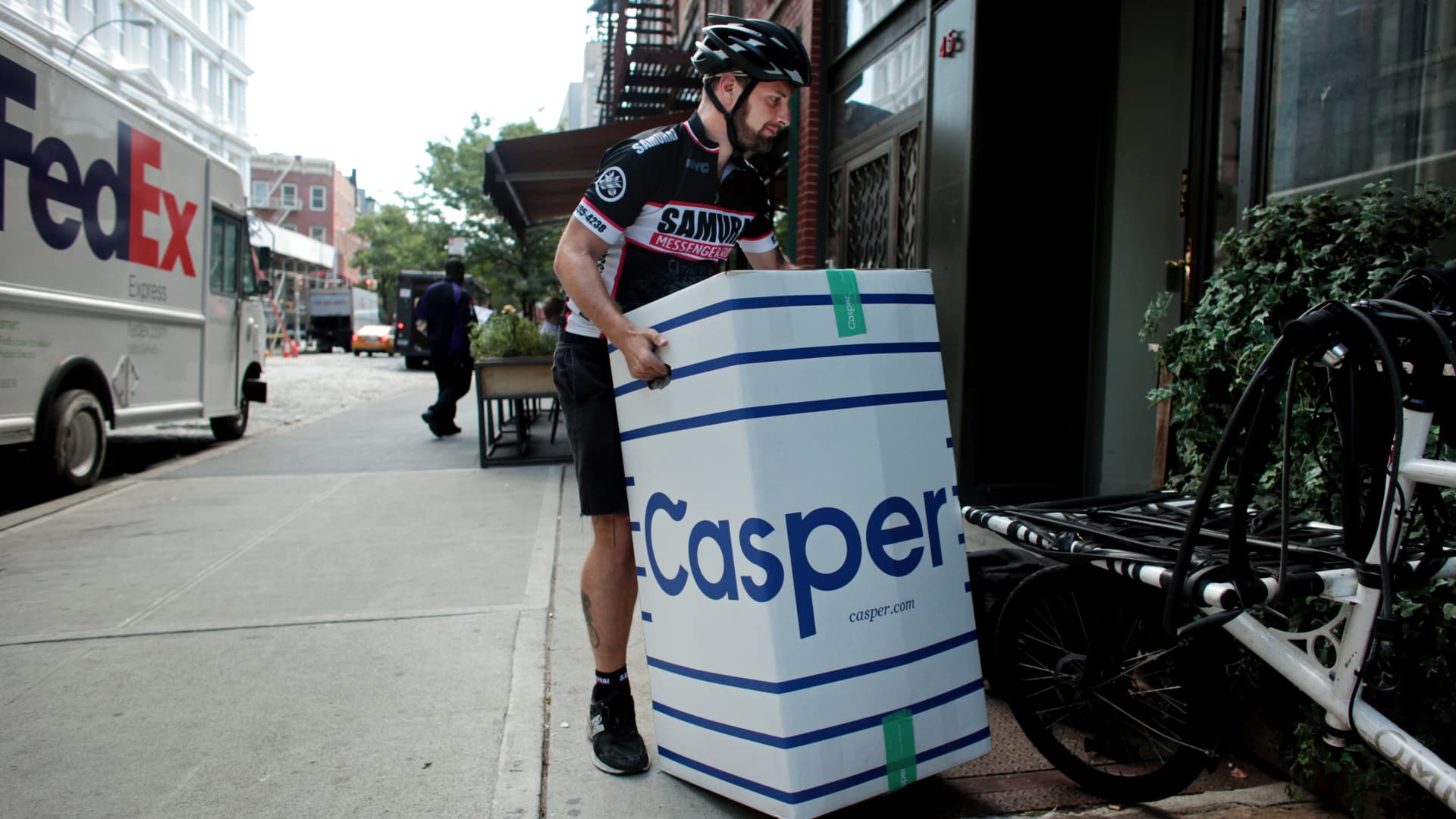
They sold all forty in twenty-four hours. When that shipment arrived, the five founders hauled the boxes out onto the cobblestone streets of Manhattan, relabeled them, and shipped them back out the same day. No warehouse. No logistics team. They hadn’t had time to build either.
By the end of that month, they had done $1 million in revenue. By the end of 2015, $100 million. The year after, $200 million.
What they had built was a systematic takedown of every friction point the mattress showroom created. One product. No choice paralysis. Transparent pricing: $850, shipped to your door. A box that fit through any door. A 100-night trial. Free pickup and full refund if you didn't want it.
The box was the answer to Luke Sherwin's walkup problem: it arrived like any package, through any door, up any staircase in the country. The 100-night trial was the answer to "I need to feel it first." A hundred nights in your own bed beats ten minutes on a showroom floor by every measure that matters. The pricing was the answer to "how do I know I'm not getting ripped off."
By the Playbook, They Nailed It
I’ve written a lot about disruption. It’s in the name, after all.
In Disruption Is Not What You Think, I argued that disruption doesn't mean attacking a competitor. It means challenging the assumptions that define how an industry operates, and serving customers the incumbents weren't building for. In The Path to Deliberate Disruption, I laid out how to engineer disruption as a strategy rather than stumble into it. In Your Product Is Better. That's Why It's Going to Fail., I made the case that category creation is the path to lasting market position.
Casper hit every mark. If you ran it through the Disruption Canvas, Casper would pass with flying colors.
They challenged the assumption nobody had examined: that mattresses had to be sold in person. They served the customers the incumbents didn't believe existed: people willing to buy a mattress they've never seen in person. And they created a new category and defined what it meant.
Within a few years, 175 companies had entered the space behind them. One hundred and seventy-five companies don't chase a category that doesn't exist.
The Part Nobody Leads With
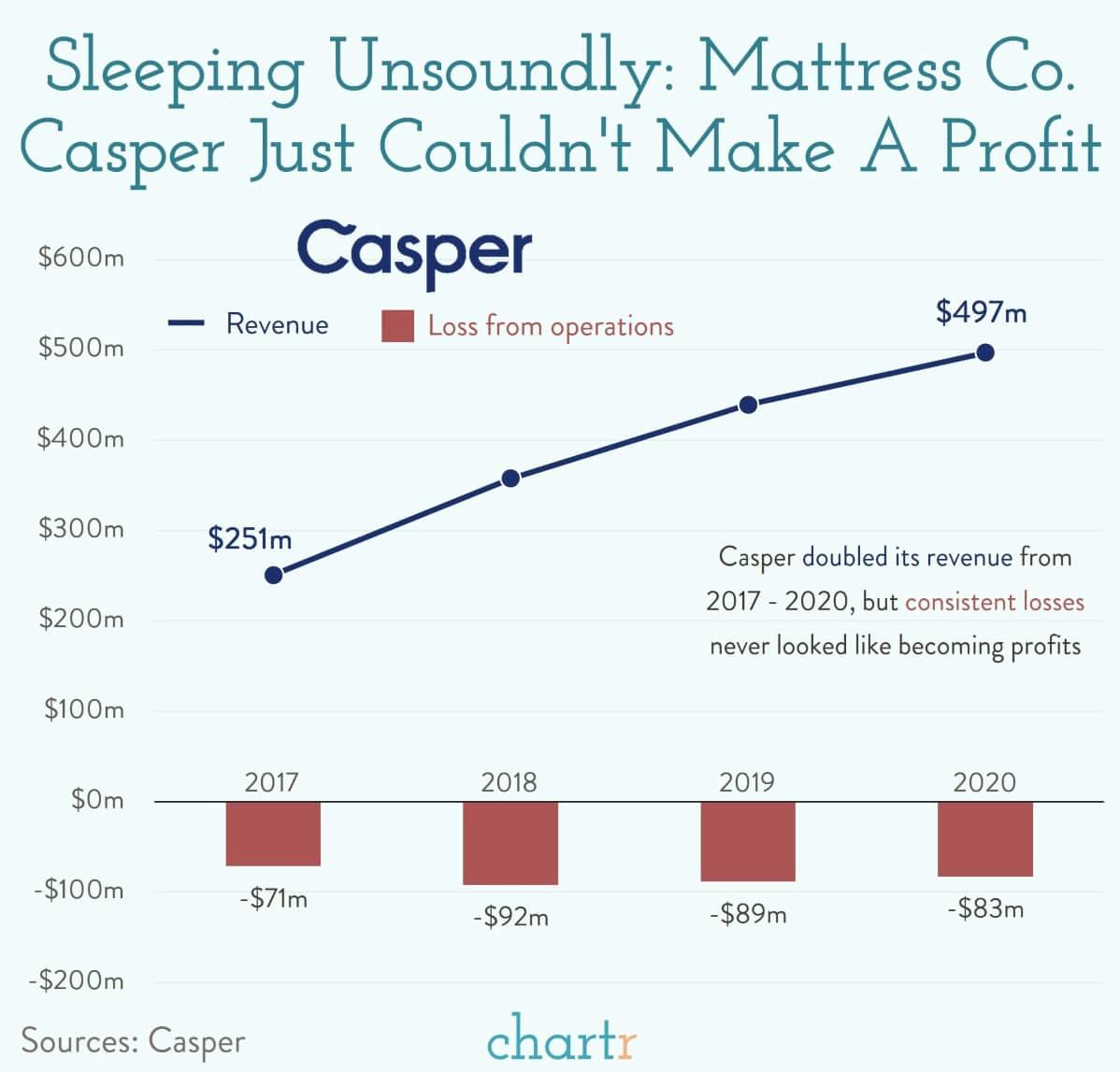
At its peak, Casper was valued at unicorn status: more than $1B. By the time they IPO'd in February 2020, their market cap had slipped to $575M, more than 40% below their highest valuation.
Two years after going public, Durational Capital Management bought the entire company for approximately $310 million. The $6.90 per share they paid was framed as a premium, 94% above where the stock had been trading the week before. That's how far it had fallen.
All told, eight years after five founders sold out forty mattresses in twenty-four hours and changed how an industry worked, the company was absorbed at a fraction of what it had once been worth.
The disruption was real. But the company didn't survive it.
What Went Wrong
Three things, in sequence.
The first: the model couldn't be owned.
A factory relationship, an e-commerce setup, and a trial period. That was the entire formula. Casper proved the category existed. But the 175 companies that followed proved it could be replicated in months by anyone with a manufacturing relationship and a Shopify account.
The friction they removed was the entry point. It was never the moat. Harvard Business School published a case study on Casper in 2016. They titled it "Marketing the One Perfect Mattress for Everyone." They had it right; marketing was the differentiator.
The second: they lost the thread.
Somewhere between the IPO and the rescue acquisition, Casper tried to become a sleep brand. Dog beds. CBD gummies. A smart nightlight. Each one a small drift from the clarity that had made them matter. A company that had succeeded by doing one thing well started doing several things in a crowded market without a clear reason to choose them over anyone else.
The third: they became the thing they had disrupted.
As copycats matched their price and margins compressed, Casper did what disruption theory prescribes: move upmarket. They repositioned as a premium sleep brand. They opened stores. A place to touch the product, feel the quality, understand why this one cost more than the others.
They had spent five years convincing people they didn't need to feel a mattress before buying one. Then they built showrooms so people could feel a mattress before buying one.


What This Adds to the Playbook
Everything we've said about disruption remains true. Find where an industry's assumptions have stopped serving the customer. Remove the friction. Get there first.
But Casper is the case study for what the playbook is missing.
Here's what that means in practice.
Ask the defensibility question before you start scaling.
Not "when will someone copy this?" The answer is immediately. Instead, ask: what in this model gets harder to replicate the longer we're in business? Data advantages, customer relationships, network effects: these compound. Execution-based models don't. Casper's entire formula was execution. A factory relationship, a trial period, an e-commerce setup. Visible from day one. Replicable in months. Scaling it didn't build a moat. It built a roadmap.
Understand what your category's purchase cycle means for the customer relationship over time.
The businesses that survive their own disruption are the ones where that relationship compounds: more data, more trust, a product that improves the longer someone uses it. If your category's purchase cycle runs once a decade, none of that is available to you.
Casper's first customers bought in 2014. Mattresses last 7 to 10 years. That cohort wasn't coming back until 2021 at the earliest, which is exactly when the company was in freefall. Casper saw the problem and tried to fix it with dog beds, CBD gummies, and a smart nightlight. The instinct was right. The products were wrong. Shorter-cycle adjacencies (bedding, pillows, anything that brings a customer back annually) would have built the relationship the mattress never could. The question to ask before you scale: does this category make compounding possible at all? If not, what adjacent product does?
Know what business you're actually in.
Casper wasn't a mattress company. It was a buying-experience company that sold mattresses. A mattress company moving upmarket asks: how do we sell more expensive mattresses? A buying-experience company asks: how do we remove friction at the premium end of the market? Those questions have different answers. Casper kept asking the first one.
Disruption earns you market entry and early proof. But it doesn't guarantee longevity. Just ask Casper, Kodak, Blackberry, or MySpace.
Share This
The Disruption Canvas

If you haven't used the Disruption Canvas to map where your industry's assumptions are breaking down, start there. It will tell you where the entry is.
What it won't tell you is what to build after you're in. That's the question Casper left unanswered. It's worth spending as much time on as the disruption itself.
How did this edition land for you?


